WeBWorK Homework For Exam 1 (final submission due 21 September at 11:59PM)
HW1 - Algebraic Expressions
HW2 - Equations and inequalities and exponents and radicals
HW3 - Functions
HW4 - Exponentials and logarithms
HW5 - Limits
For Exam 2 (final submission due 26 October at 11:59PM)
HW6 - Intro to Differentiation
HW7 - Derivatives of common functions
HW8 - Product and quotient rules
HW9 - Chain rule and implicit differentiation
HW10 - Related rates
For Exam 3 (final submission due 23 November at 11:59PM)
HW11 - Optimization
HW12 - Antidifferentiation
HW13 - Integration For Final Exam (final submission due 14 December at 11:59PM)
HW14 - Fundamental theorem of calculus
Quizzes For Exam 1
Quiz 1 (due 27 Aug in Blackboard) [soln]: Add $\dfrac{5}{x-1} + \dfrac{2x}{3x-1}$ and simplify the result.
Quiz 2 (due 29 Aug in Blackboard) [soln]: Solve the rational equation $\dfrac{6}{p-2}-\dfrac{3}{p+2}=\dfrac{7}{p^2-4}$.
Quiz 3 (due 3 Sep in Blackboard) [soln]: Solve the inequality $\dfrac{2}{x-1}+\dfrac{5}{x+1}>0$.
Quiz 4 (due 5 Sep in Blackboard) [soln]: Given $h(\phi)=(\phi+2)^2-\phi$, compute $h(2)$, $h(5)$, and $h(x+1)$.
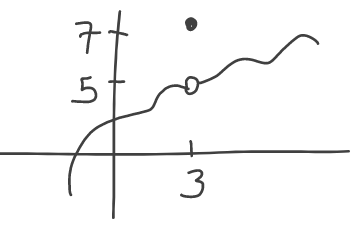
Quiz 5 (due 10 Sep in Blackboard) [soln]: Find (if it exists) these four things: $\displaystyle\lim_{x \rightarrow 3^{-}} f(x)$, $\displaystyle\lim_{x \rightarrow 3^+} f(x)$, $\displaystyle\lim_{x \rightarrow 3} f(x)$, and $f(3)$ in the following graph of the function $f$:
For Exam 2
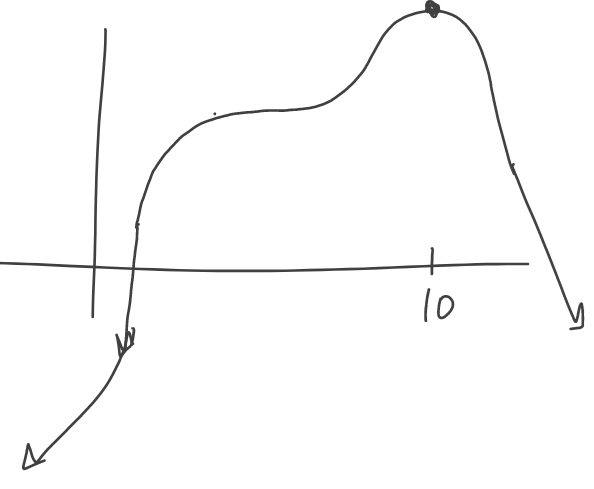
Quiz 6 (due 12 Sep in Blackboard) [soln]: Tell me where the following function has a positive derivative:
Quiz 7 (due 24 Sep in Blackboard) [soln]: Find an equation for the tangent line to the curve $h(x)=7x^2-5x+4$ at $x=1$.
Quiz 8 (due 1 Oct in Blackboard) [soln]: Let $f(x)=(x^2+5x-3)e^x$. Use the product rule to compute $f'(x)$.
Quiz 9 (due 3 Oct in Blackboard) [soln]: Let $f(x)=\dfrac{e^x}{5x^2+3x-7}$. Use the quotient rule to compute $f'(x)$.
Quiz 10 (due 8 Oct in Blackboard) [soln]: Find an equation to the tangent line of the "strophoid" curve $y^2=\dfrac{x^2(1-x)}{1+x}$ at the point $\left(\dfrac{1}{2},\dfrac{1}{\sqrt{12}}\right)$. Additionally, plot this curve, the point, and your tangent line as we have done many times in class.
Quiz 11 (due 15 Oct) [soln]: The Stefan-Boltzmann law is an equation that relates the power radiated from a black body (e.g. black hole) in terms of its temperature. It is given by $J=\sigma T^4$ where $J$ represents the total energy radiated per unit surface area of the black body per unit time, $\sigma \approx 5.670$ is a constant called the Stefan-Boltzmann constant, and $T$ represents temperature (measured in Kelvin, $K$).
If the temperature is decreasing at a rate of $3 \dfrac{\mathrm{K}}{\mathrm{hr}}$, then how is the total energy radiated per unit surface area per unit time changing when the temperature is $T=100K$?
For Exam 3
Quiz 12 (due 29 Oct) [soln]: Let $f(x)=2x^2-5x+2$. Find and classify all local extrema of $f$.
Quiz 13 (due 7 Nov) [soln]: Find all antiderivatives of the function $f(x)=5x^2+x-5$.
Quiz 14 (due 12 Nov) [soln]: Solve the initial value problem $\left\{ \begin{array}{ll}
y''(x)=x^2+3x+2 \\
y(1)=2, y'(1)=3 \end{array}\right.$